Monday, 19 January 2015

Gold & Central Banks

Growing distrust in the central banks
During the last round of the global financial crisis, bold decisions made by central banks around the world did avert a collapse of the then fragile economic systems. The loose monetary policies adopted in the US have probably rescued the nation from entering into another "Big Depression" as we knew in the 1930s. Nonetheless, the zero interest rate policy (ZIRP) has been in place for more than a "considerable period". The economy has not been able to grow in a robust manner as in the previous economic rebounds. The average annual GDP growth is around 2.5% in the aftermath of the 2008 crisis. Chairperson of the Fed, Dr. Janet Yellen, said once the economy is strong enough to stand on its feet, the Fed would start increasing the Federal fund rates gradually and "with patience." With the revised GDP growth in Q314 standing at 5% and the unemployment rate at 5.5% last December, many stock investors probably believe our economy is indeed the best among the G-7 countries. They expect the Fed start hiking rates later this year. The bond investors, nevertheless, beg to differ.
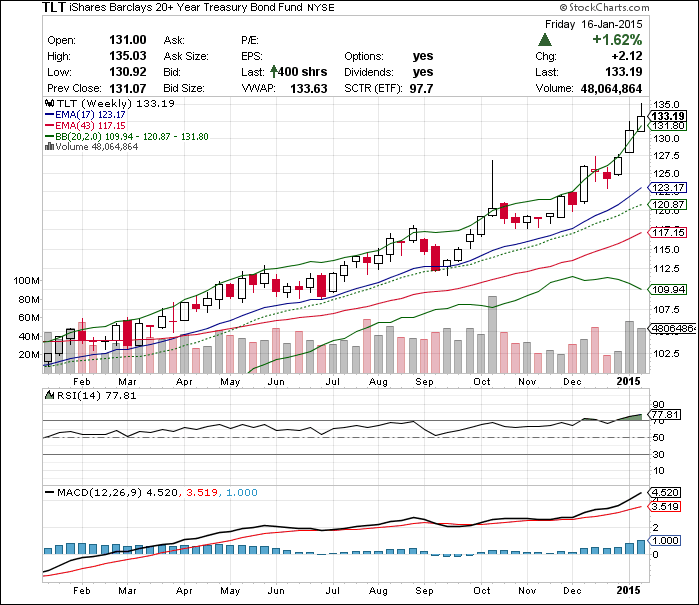
Look at the price actions of the US long-term government bonds in the past 12 months. iShares Barclays 20+ Years Treasuries Bond Fund (NYSE: TLT) is a very popular ETF betting on the appreciation of the fund price when interest rates go down. What the chart is revealing is that bond investors do not believe that the Fed would honor its words. Put it in a more diplomatic manner, they do not believe the Fed would not be able to raise rates because there is very little economic growth both in sight and in the pipeline. The latest statement from one of the Fed's top officials did contain such ambiguity. Last Friday San Francisco Federal Reserve Bank President John Williams said:
"There is no need to rush to raise rates; at the same time we want to make sure that we appropriately act in a way that we don't get behind the curve. If the forecast evolves the way I expect, six months from now or whatever - middle of this year - I think we'll have a better position to understand either well we need to wait longer, or maybe it's we could act now."
(click to enlarge)
Source: Stockcharts.com
The chart simply shows that the bond investors who are always considered to be more prudent, if not more intelligent, have ruled out any chance of a rate hike in 2015. If they had listened to the talk of the Fed and trusted what the Fed would do, the prices of the Treasuries would have been gone down instead of going up. When it comes to bond investing, high interest rates would always bring bond prices down and vice versa.
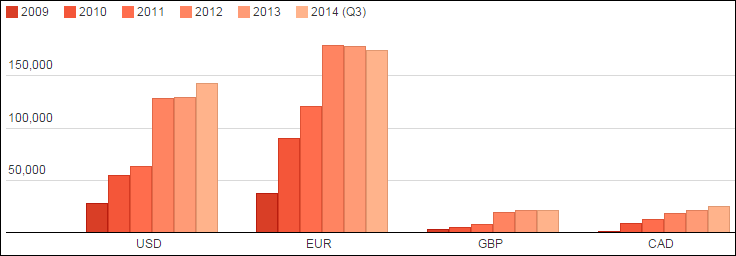
There are good reasons not to trust the central banks. The sudden reversal of the Swiss National Bank (SNB) last week to de-peg its national currency from the Euro is the best example to show how a central bank could dishonor its commitment overnight. Few days before the policy reversal, the central bank vowed that the peg was a "cornerstone of the country's monetary policy." Nonetheless, the good intentions of SNC to prevent global funds from flowing into Switzerland during the Euro zone crisis resulted in a fast accumulation of foreign currency reserve. In order to cap the exchange rate of one Euro to 1.2 franc, SNB ought to keep the printing press rolling to enable it to keep buying Euro. This is the only alternative in a current peg to keep the Swiss franc from going strong. However, the declining Euro due to anemic economic growth in the Euro zone has proved to be a financial burden too much for the country.
(click to enlarge)
Source: Swiss National Bank
The de-pegging decision led to an immediate 10% plus rise in the value of Swiss franc against almost all major currencies. Many retail and institutional investors were caught unprepared. The "Black Swan" has created havoc in the financial markets. The sudden unexpected upswing in the Swiss franc has caused bankruptcy of two relative small foreign currency traders in the UK and New Zealand - Alpari and Global Brokers NZ.
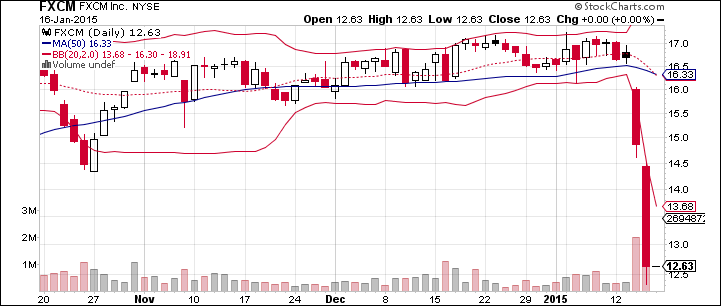
In the US, a New York-based currency broker FXCM, confirmed late Friday that it was getting a $300 million rescue loan from financial firm Leucadia National Corp. The online currency trader was about to breach regulatory capital requirements following a $225 million loss by its clients overnight. 
(click to enlarge)
Source: Stockcharts.com
Trading resumed in the after-hours on Friday and the last trade was at $4.3. Compared with the stock's closing price at $17 one week prior, the stock lost 75% of its value. The extent of financial instability brought about by an unanticipated move of a major central bank cannot be underestimated.
The global currency trading market is huge estimated at nearly $2 trillion turnover per day on the spot market. The real carnage to major US banks and other financial institutions are unknown as of now. Regulators in New Zealand, Hong Kong, Britain and the United States said they were checking on brokers and banks to assess the consequences after reports of volatility and losses. The incident shows that any change of mind by any major central bank on set policy goals would send ripples or cause severe turmoil to the global financial system.
The incident serves to remind stock investors that they should not place complete trust in decisions of the central banks. Take the Bank of Japan (BOJ) for example. The unprecedented stimulus program launched by BOJ in the past two years has failed so far to bring the country out of deflation. The 2% inflation rate it vowed to reach remains a remote target. On the contrary, the trade surplus Japan used to enjoy for decades because of its stellar export performance has turned negative. The current account is in the red. The national debt keeps rising to over two times of its GDP. Many critics suggest that the failure of BOJ's QE program would lead the country and even the world into uncharted waters.
A critic on Reuters Breakingviews who is skeptical about the ability of central banks to fight deflation reminded investors that central bankers are not omnipotent. Here is what the columnist Swaha Pattanaik wrote:
"Swiss monetary policy did not work as planned. The Bank of Japan, and the ECB, which is expected to launch a government bond-buying program soon, may not be any more successful. The U.S. Federal Reserve and the Bank of England do not have to worry much about stimulating growth now, but if they do, their arsenals are depleted"
The ECB chief Mario Draghi vowed to do "whatever it takes" to save the Euro in 2012. He succeeded. On Thursday, when the ECB announces its scheduled plan to resurrect the Euro zone inflation, I believe the market would not respond mildly to the long overdue solution. Any disappointment might lead to another round of havoc or volatility in the financial markets. Against this kind of uncertainty, retail investors must monitor the equity markets closely or take profits first to protect their portfolio.

Gold is again becoming a sought-after safe haven

Like the Swiss franc and the greenback, gold has always been a safe haven when fears abound. In the past three years, investors dumped gold because the precious metal failed to serve as a hedge against inflation. Nor could it generate any recurrent income for the yield-hungry investors. The everlasting function of gold as a safe haven has never vanished. The recent turnaround of gold against the ever-stronger US dollar implies that a pocket of investors is finding the macro-environment worrisome. They are re-examining the value of the long-neglected asset class as a "currency" besides its universally accepted status as a safe haven during bad times.
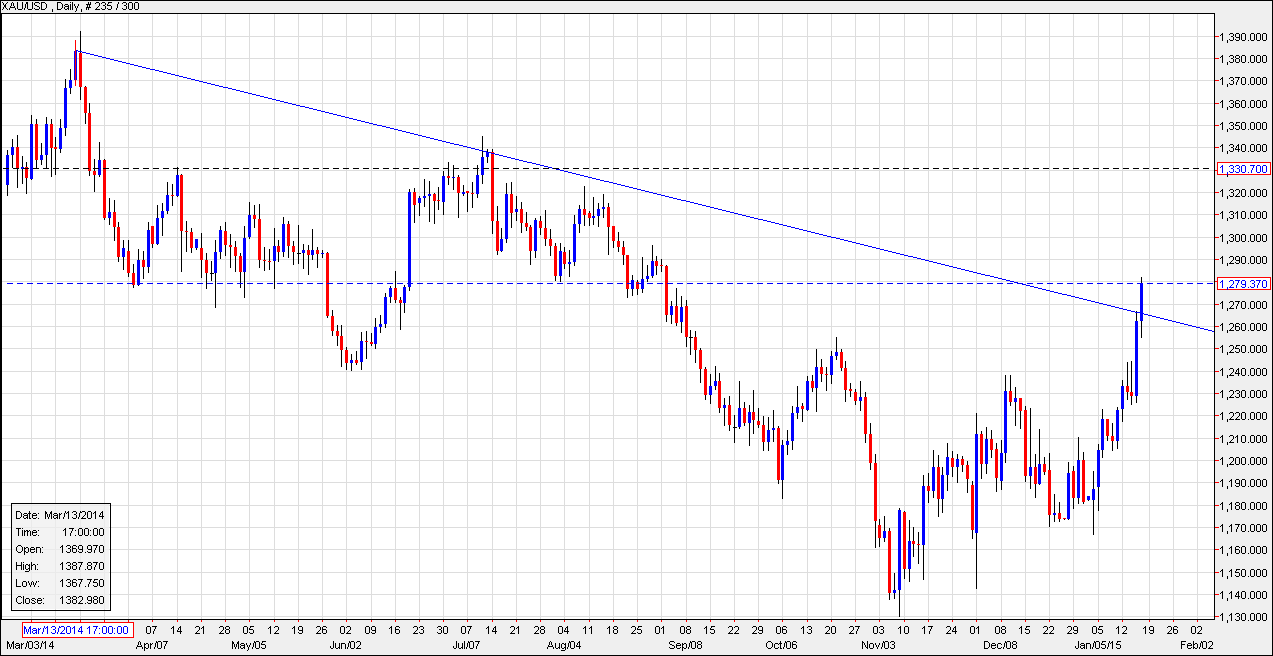
Some investors have already moved in. According to Bloomberg, holdings in the SPDR Gold Trust (NYSEARCA:GLD), the biggest exchange-traded product backed by the metal, surged the most in more than four years. Assets in the SPDR fund jumped 1.9 percent to 730.89 metric tons last Friday when the metal closed at $1,280 - a four-month high. The holdings climbed 3.3 percent last week. With regards gold futures, call options for the right to own February futures at $1,300 an ounce soared sevenfold in two days
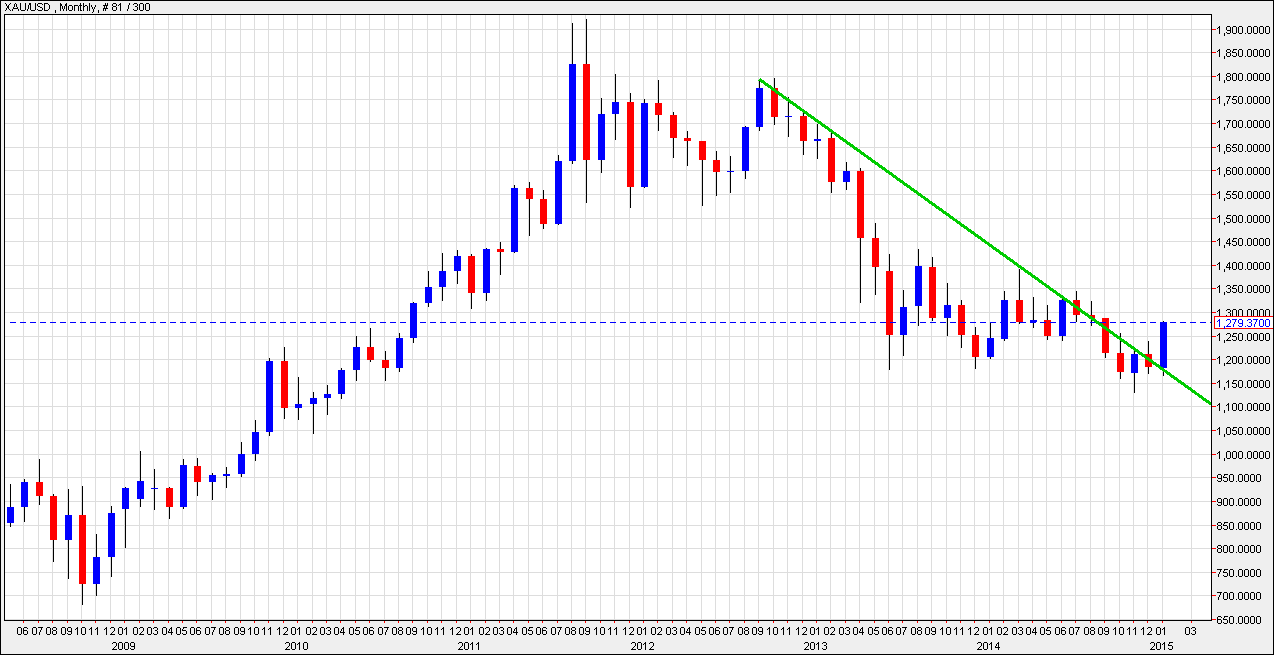
As of last Friday, gold has increased 12% from the 52-week low recorded last November. Most importantly, gold has two important technical breakthroughs. First, it broke above the downward daily trend line extended since last March.
(click to enlarge)
Source: Stockcharts.com
Second, in the monthly chart below, the gain in January 2015 represents a conspicuous breach above the down trend line extended from late 2012. This could be a very meaningful technical breakthrough, hinting that the time for a long-term turnaround is coming provided gold could retain its current strength by the end of the month.
(click to enlarge)
Source: Stockcharts.com
The fact gold regains the favor of investors is not by coincidence. The growing mistrust in the central banks may have led to a trend reversal of the gold prices. The concerns about an upcoming deflationary environment i.e. the first red flag mentioned at the beginning of this article are probably another contributing factor.
"It is living up to its reputation as a safe haven as other cyclical commodities are tumbling, equity markets are down, and we are seeing higher risk aversion almost everywhere."
"Gold is popping because fear is coming back into the marketplace and gold is regaining its stature as a safe-haven commodity. Look at what has happened with the global central banks today. The surprise - you know - black-swan move by the Swiss National Bank is not creating more confidence; it is creating less confidence. And people are running back to gold."
Author of the well-known investment letter Gloom Boom Doom Report, Marc Faber also attributed the growing fear to the failure of central banks to deliver what they promise. He expected gold could jump 30% in 2015.
"My belief is that the big surprise this year is that investor confidence in central banks collapses. And when that happens - I can't short central banks, although I'd really like to, and the only way to short them is to go long gold, silver and platinum."

Wednesday, 14 January 2015

The Enigmatic David Bowie

Absolutely fabulous, always cool ... the morphing looks of DB over the years.

Monday, 12 January 2015

Great Food Find ... Steamed Fish @ 1990 Prices

Thanks to the market tanking and quite a horrible year for most, not to mention the oil prices ... its time we all tighten our belts. What a find, this place is hidden at the backlane, and when you see the shop, you don't really want to go there. But actually the owner is fanatical about cleanliness despite the look of the place. Its packed to the rafters all the time.

Specialty is their steamed fish with ginger, or rather river fish. I know some may not like river fish being steamed as they say you can taste the mud, seriously folks ... thats too atas.


Look at the bill ... two steamed fishes, a veggie dish plus taugeh dish and tea ... RM87.20!!! Food rating: 9/10. Ambience: 1/10. Value for money: 10/10.

LOCATION: (take note of the word "behind")
Behind - 91 Jalan Waras 3, Taman Connaught Cheras, Kuala Lumpur, 56000, Kuala Lumpur, WP Kuala Lumpur, 56000 (opens  for lunch and dinner)

Although they seem to have another branch but my friend insisted that the original god forsaken place is still tops.

18-20, Jalan 15A/142, 
Taman Orkid Desa,
56100 Cheras, KL.
Tel : 016-665 6331 
Operation Hours : 05:30PM - 10:00PM
Closed on every Wednesday

Friday, 9 January 2015

Let's Listen To What David Suzuki Has To Say

DAVID SUZUKI CRIES FOR HIS GRANDKIDS

David Suzuki, Founder of the David Suzuki Foundation

If I were to say that this 20 minutes interview was the best piece of radio I have heard for the longest, that would be short changing it. Thats because the subject matter is graver than religion. Its relevance greater than most of us would like to admit. Its humbling, even guilt-inducing at times because we can care more. I am still thinking how we can make the things he said more "actionable for normal people", its too safe to just nod and say that was great radio and content.

http://www.bfm.my/breakfast-grille-david-suzuki.html


Thursday, 8 January 2015

Asset Class Performance As At 31 December 2014

I don't know about you but the recent calamity in the markets, caused by a massive drop in oil prices and to a lesser extent other commodities, plus a sharp rise in USD vis a vis most currencies ... kind of makes me mad. Why ... why is it that the US does not get punished for printing truckloads of currency, why their debts need not be serviced ... and when they have to raise rates, all the smaller nations get whacked.

US real estate investment trusts (REITs) led the performance race in December among the major asset classes, rising a healthy 1.9% in the final month of 2014. US REITs were also the top performer for the calendar year among the major asset classes.  For the rest of the field, returns in December were mostly flat to negative. The big loser last month and for 2014 as well: commodities. The US stock market was flat last month, although for year just passed US equities earned a respectable 12.6% (Russell 3000). That’s a comparatively soft gain relative to the stellar advance for US market in the last few years, but it’s above average in comparison with long-term results.

Meanwhile, portfolio diversification faced strong headwinds last month and for 2014 overall. The Global Market Index (an unmanaged benchmark that holds all the major asset classes in market-value weights) retreated 1.1% in December. For all of 2014, GMI earned a relatively soft 4.1% — a sharply lesser gain vs. 2013’s 14.2% advance.
GMI’s diminished performance last year is disappointing in the context of recent history, but the downsizing of return isn’t particularly surprising. Forward-looking risk-premia estimates for GMI have been in the neighborhood of 4.0% lately (see last month’s update, for instance). By contrast, GMI’s historical risk premiums have been running at roughly twice that pace in the last several years, based on the trailing three-year period. But as December’s numbers suggest, the wide gap between hefty profits in the rear view mirror and lean expectations for the future is closing. 
The implication: minting impressive returns with a passively managed multi-asset class strategy is going to get tougher in the foreseeable future. The solution for sidestepping softer results? The standard toolkit, of course — excelling in rebalancing and/or second-guessing Mr. Market’s asset allocation. In other words, generating a portfolio return that’s comparable to what we’ve seen over the past five years will probably require a higher dose of risk.

Monday, 5 January 2015

Greece Is The Word ...


Why the renewed talk of a Grexit from the eurozone?
Greek Prime Minister Antonis Samaras has called a snap election for January 25. Unfortunately for Mr Samaras, the narrow front-runner for the election is his opponent Alexis Tsipras, head of the leftist Syriza party. Mr Tsipras wants Greece to remain in the Eurozone, but he also wants parts of Greece's debt written off and austerity measures reduced. It's not certain whether the rest of the Eurozone - and in particular, Germany - will accept this. Greece could be forced to leave the Eurozone.
What would happen to Greece if it left the eurozone?
The scenarios range from mildly painful to catastrophic. At the very least, leaving the euro and writing off large amounts of debt would make Greece a pariah in international capital markets - who wants to lend money to a country that doesn't repay? Greece would be forced to reintroduce its old national currency, the drachma, and it would be a difficult transition from the euro. But Greece would again have its own currency and central bank and be able to directly steer its economy.
Still, the resulting turmoil could make Greece's economic position even worse than it currently is. The doomsday scenario is political unrest that could lead to civil war and a military coup.
What would happen to the European and world economies if Greece left the eurozone?
Europe's economic position is far better now than the crisis years of 2009 and 2010. German leader Angela Merkel has stated that she would be willing to accept a Grexit because the feeling is that the Eurozone would be able to hold together if Greece left. This would still be enormously expensive - costing billions of Euros - and financial markets worldwide would take a hit. American academic Barry Eichengreen said the impact of Greece leaving the euro would be "Lehman Brothers squared".
Previously, it was believed that if Greece wrote off their debt and left the euro, other troubled European economies - Portugal, Ireland, Spain, Italy - could follow. There is still a small chance this could happen. The implosion of the Eurozone would have dire consequences for the Europe and the world.
So how bad is Greece's economy?
Since 2008, the year the global financial crisis began, the economy has shrunk an astounding 25 per cent. If the Greek economy grew at 2 per cent a year, it would still take 13 years to get back to its 2008 size. 
Greece's debt as a proportion of GDP was 105.4 per cent in 2008. It soared to 171.3 per cent in 2012, shrunk to 156.9 per cent in 2013, but reached 174.9 per cent last year - higher than ever. Only Japan has worse debt. Greek unemployment is at 25 per cent. And because Greece has neither its own currency or central bank, it can't devalue the exchange rate or introduce monetary stimulus to improve its economy.
In short - the Greek economy is in terrible shape.
What do bond markets think about a Grexit?
Southern European bond yields have risen in recent days but are still very low, reflecting the belief that the fallout from a Grexit can be "ringfenced". Spain's 10-year yield touched a record-low 1.49 per cent on January 2 and is now at 1.60 percent. Italy's 10-year rate reached a record low 1.73 per cent on January 2 and is now at 1.83 per cent.
By contrast, the Greek 10-year yield has increased 41 basis points to 9.65 per cent. Despite the rise over the past weeks, it's still well below record high yields of more than 30 per cent hit in 2012.
  

Sunday, 4 January 2015

What The Government Should Be Doing For Flood Victims

It looks pretty obvious that maybe not enough has been planned to mitigate the repercussions from the present floods' disaster. Some 200,000 have been affected, and possibly another 100,000 will be affected indirectly for those who might be dependent on the former group.

What needs to be done immediately:

a) Unit In Charge Of Logistics & Aid Distribution - self explanatory. Too many ketua kampungs acting as toll gates, preventing aid from reaching the victims.  Presently the kind of aid also changes accordingly. Many places do not need food but more so for cleaning products and medication. Right now, its a free for all. All good intentions are not properly directed, and a large portion may be wasted in the end.

b) Unit In Charge Of Infrastructure Rebuilding - A detailed study of whats immediate and whats medium term. The kind of funds needed and how to get them, and disburse projects asap.

c) Unit In Charge Debt Relief & Insurance - Many people have lost a lot of property and assets. If you have two cars under water, you are looking at RM30,000-RM50,000 in damages. Before you now it your monthly car and house payments are due again. The unit should be there to negotiate with all banks and insurance firms collectively. Maybe a grace period of one year could be given to those who apply.

d) Unit To Cater For SMEs and Companies - Looking into the after effects to companies as they are the backbone for people to rebuild lives. Without jobs, how are they going to rebuild their lives? Hence special assistance loans should be given on a case by case basis to alleviate the pain.

e) Unit To Cater For Planters and Farmers - Many crops and cultivation have been devastated. Similar to above.

This flood is a national disaster, not a leave your house and go back a couple of days later to clean up and things back to normal. Many who are middle class or lower middle class, suddenly find themselves below poverty line.

The government needs to stop playing politics and work with state governments as too many lives and livelihood are at stake. Remember, we do not have SAFETY NETS ... there is no unemployment insurance, and if you did not get extended coverages, you have lost your cars and your house needs a huge renovation loan. Not to mention those whose houses have been totally decimated as well.

Act now, act fast and decisively.